
When a loved one begins needing assistance, families often encounter two similar terms: home care and home health care.
Although the services may complement one another, they are not interchangeable. Understanding the distinction can help you ask the right questions and avoid arranging support that does not meet your loved one’s needs.
What is home care?
Home health care generally refers to clinical services delivered by appropriately qualified healthcare professionals. Depending on the patient’s needs and eligibility, these services may include skilled nursing or rehabilitation therapies.
The exact services depend on clinical requirements, the provider’s credentials, applicable regulations, and any relevant coverage or authorization.
Families should confirm whether the provider is equipped and authorized to deliver the particular service being considered.
Home care vs. home health care: the key differences
Families should confirm whether the provider is equipped and authorized to deliver the particular service being considered.
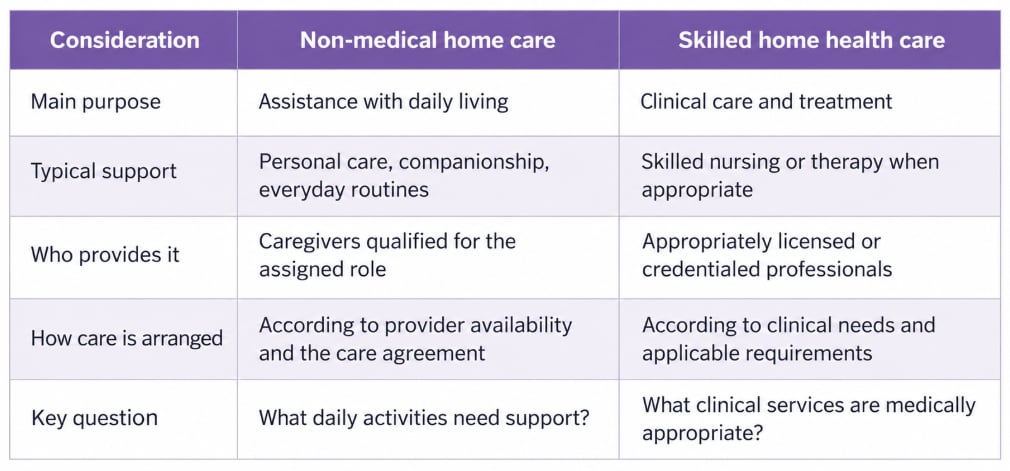
These are general distinctions. Service definitions and provider responsibilities vary by jurisdiction and program.
Which type of care does your loved one need?
Consider non-medical home care when the main challenges involve everyday activities, personal routines, companionship, or practical assistance.
Ask about skilled home health care when a clinician has identified a need for nursing, rehabilitation, or another clinical service.
Consider both when a person needs clinical treatment as well as help with daily living. Separate providers may coordinate their work where appropriate.
Five questions to ask before choosing a provider
- What specific services do you provide?
- Which qualifications or licenses are required for those services?
- Are there tasks your staff cannot perform?
- How are care needs assessed and changes communicated?
- What are the service hours, fees, and scheduling requirements?
Do not assume a company provides skilled nursing simply because it uses the words “healthcare” or “medical care” in its name.
Does insurance or Medicare cover home care?
Coverage depends on the specific service, the person’s eligibility, the payer, and the applicable rules.
Non-medical personal assistance is not automatically covered by Medicare. Certain qualifying home health services may be covered when program requirements are met. Confirm current coverage directly with Medicare, the relevant insurer, or a qualified benefits adviser.
FAQs
Only tasks permitted by the person’s qualifications, the applicable law, and the provider’s authorized scope may be performed. Clinical treatment should be delivered by appropriately qualified professionals.
Non-medical assistance may help with everyday routines after discharge, provided the person is medically appropriate for the setting and the required support is within the provider’s scope.
No. Non-medical assistance and skilled nursing serve different purposes, although they may complement each other.
Start by identifying the daily activities or clinical needs that require assistance. Then confirm the provider’s qualifications, available services, and care arrangements.
Start a conversation about home care
Explore the AAI Caring Hands Home Care service to discuss non-medical support options. If your loved one needs clinical care, ask the appropriate healthcare professional about qualified providers.
- Phone: (443) 848-2254
- Fax: (410) 730-7618
- Toll-Free: 1 (833) 473-4040
- 10709 Birmingham Way,
- Woodstock, Maryland 21163.
